Minister of Education Jiunn-Rong Yeh Came to Hualien and Presented “Taiwan’s Vision 2030 – Education”
Text: Chia-Yi Lee and Xiu-Pin Ye
Photo: Jung-Hui Hsu
Translation: J.B. Willis, Steve J. Lin
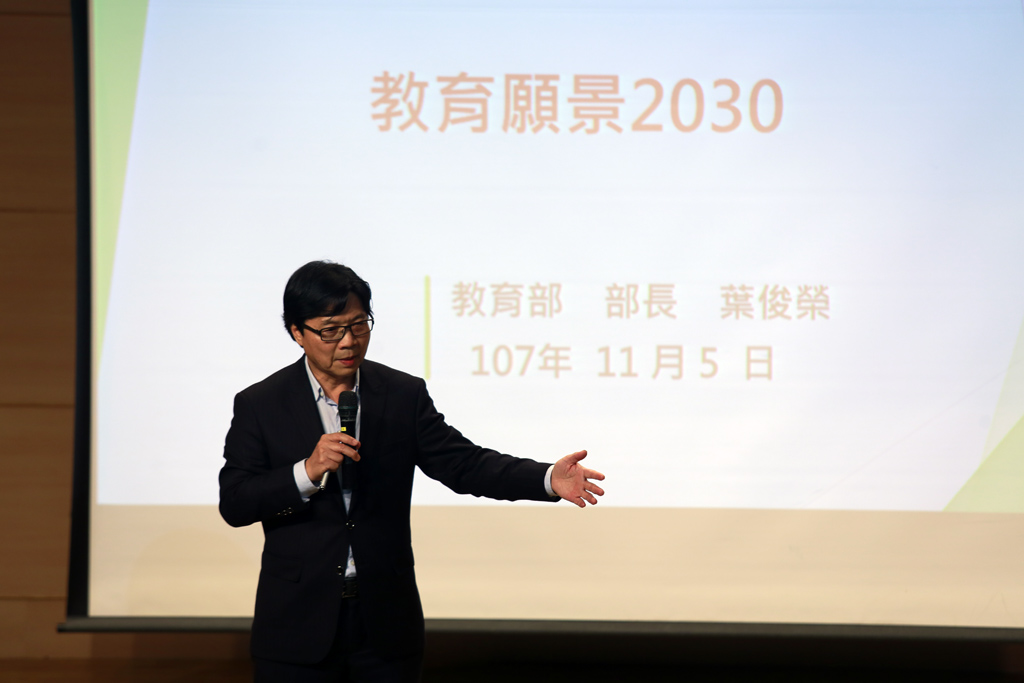
On November 5, 2018, Minister of Education Dr. Jiunn-Rong Yeh was invited to TCU to give a talk on “Taiwan’s Vision 2030 – Education.” He pointed out that Taiwan’s future will surely pivot on education. The 12-Year Basic Education Curricula, which are scheduled to be implemented in August 2019, will focus on instilling skills and knowledge, discovery of students’ temperaments and cultivation of their dispositions (a turnaround of what we have been doing,) and enrichment of students’ problem solving skills and attitudes, which they need to face the world. Since the 12-year basic education policy was implemented in 2013, primary education, secondary education, higher education and continuing education, have changed considerably. For the betterment of Taiwan, we need to continuously care about our education. After his presentation, Minister Yeh presided over a Q & A session with more than 60 people attending.
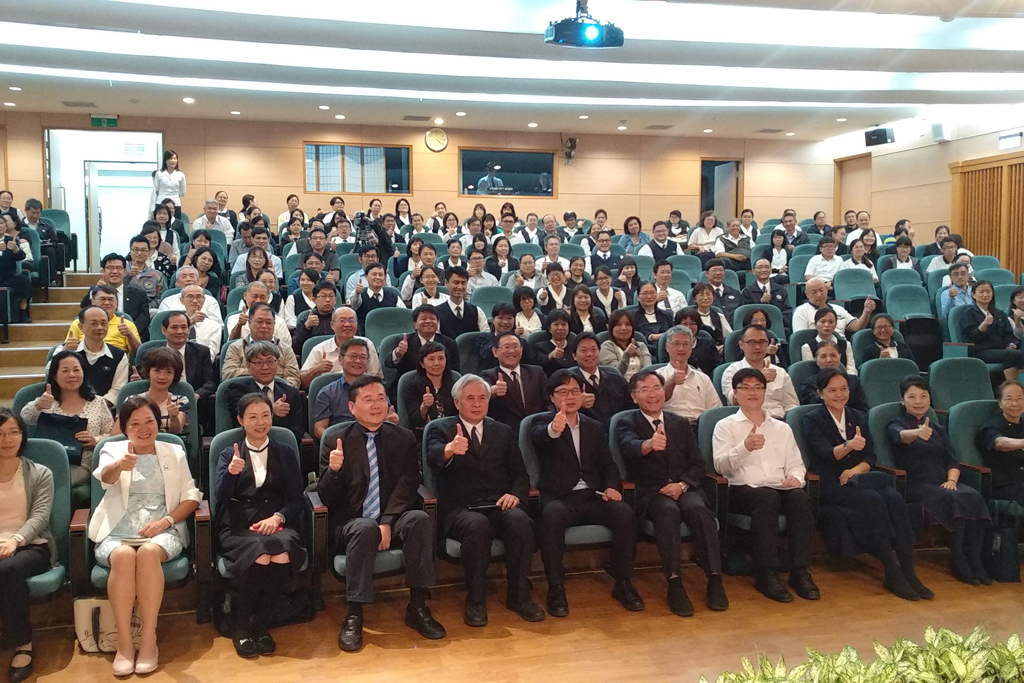
A total of 250 attended Minister Yeh’s presentation. TCU President Pen-Jung Wang expressed his thanks to Minister Yeh for giving his first public speech in Hualien, since his appointment in July 2018.
Minister Yeh mentioned that car drivers usually pay attention to the road in front of them, rather than the steering wheel they are holding. Likewise, when we talk about 12-Year Basic Education Curricula, we may focus on the fundamental changes in education that are going to take place within the next 12 years, and its success or failure will depend on how well we carry them out. Based on the new curricula, teachers will not just instill skills and knowledge into students’ minds; more than that, they will guide students to value diversity in Taiwan. Students will learn how we have prevented natural disasters from happening, and how we faced them when they occurred; moreover, students will come to know how Taiwanese accommodate and respect each other, and in what ways they treasure natural beauty and humanitarianism.
Minister Yeh emphasized that education can provide students with opportunities and empowerment. In the past, it has assisted students, families and the public to meet their needs and develop their potential, and played a major role to transform Taiwan from a deprived society to a prosperous and technologically-advanced one. In addition, education has also empowered students to notably enhance their capabilities.
For the time being, there are three major tasks for the Ministry of Education, namely enhancement of students’ international mobility, removal of unnecessary governmental controls, and empowerment of students to develop their potential to the fullest. Facing global competition, Minister Yeh reminded us that we need to know more about ourselves, and realize what we are good at. We have many good things that surround us, such as our democracy, natural beauty, harmonious society, solid industrial base, disaster prevention efforts, resilience to endure disasters, and accommodation and respect when we interact with each other.
The Ministry of Education is working on many deregulation projects, and the Degree Conferral Law is one of them. Once this law is passed, the major shown on the degree can be different from the one the student chose when first admitted. The purpose of this project is to provide more latitude to universities, faculty members and students, and moreover, to assist students to meet the needs of the workplace. In addition, the Ministry of Education also wishes to provide fine learning environments to empower students to develop their potential to the fullest.
The university’s social responsibility will help raise local uniqueness where higher education institutions are located, and connect them with local industries and other institutions. This is another thing that the Ministry of Education is determined to do.