TCU Sponsors “Nursing Leading Global Health Advancement Conference”
Text/photo: Chia-Yi Lee
Translation: Steve J. Lin
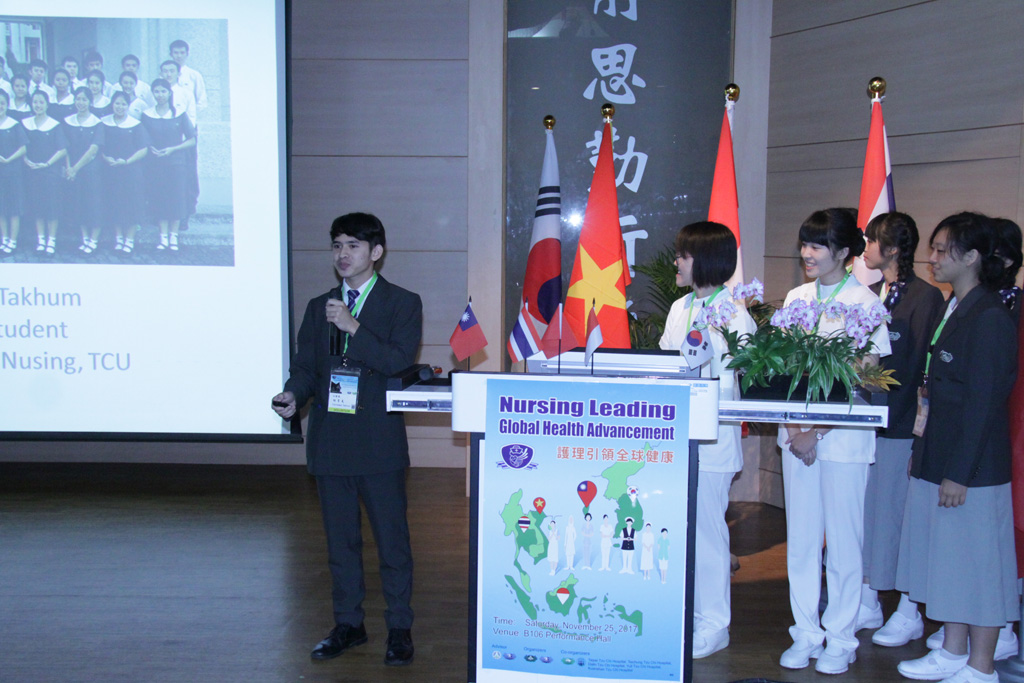
On November 25, TCU sponsored the “Nursing Leading Global Health Advancement Conference.” In response to the government’s “New Southwards Policy,” TCU invited many nursing experts from Thailand, Indonesia, Korea, Vietnam and Taiwan to give presentations at this conference. Taiwan’s medical and nursing education, as well as its healthcare policies, are highly regarded internationally, and TCU wished to share what Taiwanese are good at with these overseas experts, and also enable TCU students to expand their views, by learning from these experts how they provide the nursing care overseas.
Experts from the Ministry of Health and Welfare, Thailand’s Mahidol University, Chiang Mai University and Naresuan University, University of Indonesia, Korea’s Kyung Hee University, Taiwan’s Tzu Chi University, Hualien County Nurse Association, and the Asian Health Literacy Association gave presentations, and their presentations covered four major sections: “Global and Population Health,” “Nursing Promoting Health and Humanistic Care,” “Nursing Influencing Health Outcome,” and “Spiritual and CAM of Nurses.” The conference started with a group of aboriginal students wearing their traditional costumes presenting a dance of the Bunun Tribe, and also greeting everyone in the Bunun language.
TCU’s dean of the Office of Student Affairs, Dr. Kun-Ruey Shieh welcomed everyone. He said that it was a little cool outside, yet many people showed up, and warmed the conference venue. Now, nursing professionals are in high demand around the world, so he encouraged participants from the various countries to have dialogs with each other and exchange ideas.
Dr. Shu-Feng Tsai, director of Department of Nursing and Healthcare, the Ministry of Health and Welfare, said that we could share our experiences in National Health Insurance, the healthcare system, medical education and disease control with other countries. She mentioned our national health insurance and long-term care, version 2.0, in her presentation. Taiwan has been facing an accelerated rate of aging along with low birth rates, thus changes in family structures are gradually eroding the family support system, and elders have to rely more on the government for assistance. Thus, the long-term care policy is to let elders feel at ease in their lives.
Dr. Tsai also talked about the high turnover rate among nursing professionals. These professionals, between the ages of 30 and 40, have the highest turnover rate. She indicated that 85% of nursing professionals work for hospitals or clinics, and if healthcare institutions offer community care, it would enable nursing professionals to leave hospitals or clinics for a short period of time and go into the community, providing home care or community care, which would lengthen their professional lives and expand the diversity of their services.
The number of refugees in the world has reached the highest level ever recorded. In Thailand, refugees have come from more than forty countries, and many are living in camps. They are not allowed to work, and are without healthcare. Dr. Supapak Phetrauwan, mentioned that on their way to Thailand, many refugees suffered from malnutrition, got injured or incurred psychological problems. It was hard for local people to talk to them, due to cultural and language barriers. However, Mahidol University, which is one of TCU’s sister schools, decided to take initiatives to care for refugees’ health needs. They worked with Tzu Chi Foundation providing medical outreach to refugees living in UN camps, inviting their nursing students and six of TCU’s exchange students to join in. Those six TCU exchange students, who participated in the medical outreach, shared their feelings in today’s conference.
This year, Pei-Ci Xiao, a TCU nursing junior, went to Mahidol University and joined the medical outreach at an UN refugee camp in Thailand. She said that learning overseas and serving the needy there expanded her life horizons, and she no longer enmeshes herself in the hardship of serving in a hospital as a nursing student. Moreover, she learned from her peers in Thailand that the scope of nursing care can be widened, which includes going into the community and serving the needy there.
Internationalization is TCU’s strategic direction, and TCU has answered the government’s call to collaborate with Southeast Asian countries. On November 12, several Thai students came to TCU for a four week exchange program. One Thai student named Pongsatorn said that while studying in Taiwan, she experienced a different culture and learned nursing skills, which will be helpful in caring for her patients.
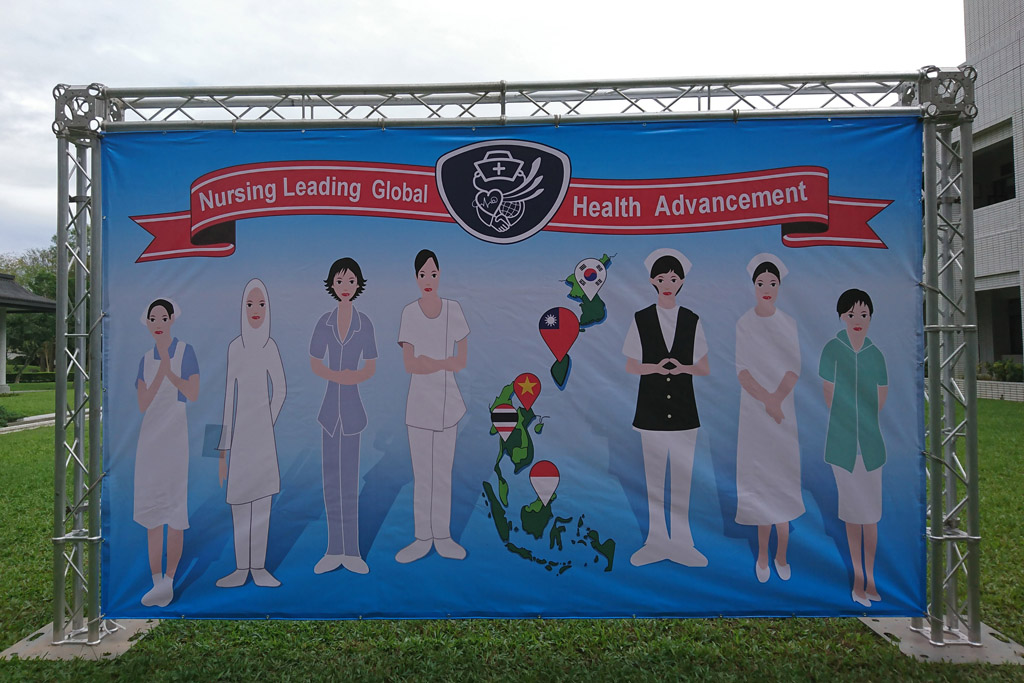
In addition to oral presentations, a poster display was also a part of this conference. Besides this, nursing students created a large poster showing nurses’ uniforms worn in various countries. Dr. Tai-Chu Peng, chairperson of the Department of Nursing, pointed out that the international conference could broaden our students’ perspective, and encourage professionals from different parts of the world to exchange their views of how to enhance everyone’s well-being by using their professional knowledge and skills.